It is ultimate frisbee in its purest form: the people, the events, the tools, the emotions, the meaning, the mentality, and the method. Everything you wanted to know about the game and how it goes down in the Ultimate world. It's called Ultimate for a reason...
Showing posts with label how to throw a frisbee. Show all posts
Showing posts with label how to throw a frisbee. Show all posts
The Hammer. Big. Bold. Daring. Maybe even Desperate.
The Hammer is a throw very different from the flick or the backhand. Why? Because it flies upside down.
While "normal" throws are released right-side up for utmost distance and accuracy, the hammer flies upside down, making it a little more difficult to place that spot-on pass. However, a throw as bizarre as this does have its place. As the stall count gets high, it is much easier to rear back and unleash a Hammer than try to sneak a regular throw past a defender.
The Hammer is thrown more like a baseball than a frisbee. Take the disc in a grip similar to the flick (see The Flick for details), and release it upside down over your head. The key to a strong hammer is a well-timed release and a strong snap of the wrist. These take a lot of practice to place them where you want to. They make good arching throws that can really clear a field of defenders better than a flick flying at head level.
Visual learners, check out this video if you want to see how it's done.
Do you play frisbee? Wait, let me rephrase that: do you PLAY frisbee? This is the throw that differentiates between frisbee players and frisbee PLAYERS. Real players mean business, and real players throw flick.
The flick (or forehand) is a must-know in advanced frisbee leagues. It is difficult to defend and easy to control (if you know what you're doing). But, like all throws, the only way to make your flick unstoppable and spot-on every time is to practice.
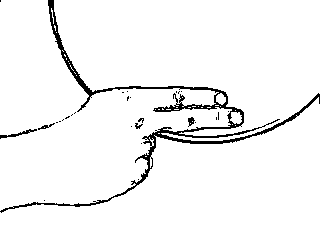
A proper flick can be held multiple ways before it is "flicked" (released). The Walking Man is the preference of many, spreading one's index and middle finger on the underside of the disc, ring and pinky fingers enclosed in the fist and thumb outside the lip of the disc (see picture). Another popular grip is similar, but the index and middle fingers are placed together against the inside lip under the disc (see picture). These are the most widely used flick grips, however variations do exist. Combinations of three fingers or one finger placed under the disc can also produce and effective flick. As always, practicing and finding what works best for you is well-advised.
The best flicks are thrown with the strongest wrist. The more a disc is spinning the farther it will travel. That said, when you prepare to release, make sure your wrist is working overtime and your arm is on vacation. Your shoulder should not be the propelling force of your throw, rather, it must come from your wrist.
If you find yourself trowing blades (disc slices the air vertically instead of flying horizontally), try dropping your wrist (lowering the outside of the disc) when you release. Throwing proper flicks without slicing can be difficult at first, but this can be corrected with practice.
Using your non-dominant foot as your pivot foot, step out (away from your pivot foot) with your dominant foot as you release with your dominant hand. This will make your throw much more difficult to defend. Another way to prevent slicing is adjusting the position of your step and the angle of your body as you flick.
The flick is most commonly used in games as a direct, accurate pass for any length. The best players can throw a flick the length of the field, and show-offs can throw it between their legs.
Play on, ultimate players, play on!
For a VERY detailed description of how to throw a forehand,
This is the throw, the throw that started it all. It's the throw you learned in gym class. It's the throw that players at all levels began with, the launch pad for frisbee careers. It is what the right hook is to boxing, or the scissors to arts and crafts time. It's necessary.
A backhand is thrown by gripping the disc, top facing up, in the dominant hand (the one you feel most comfortable throwing with). In gym class, you may have been taught to place your index finger along the edge of the disc (other fingers curl up under the disc) and upon release, point to where you are throwing as a means of boosting accurately (as seen here).
This is acceptable, however if all fingers (except the thumb, which remains on top of the disc) are tucked under the disc, the power you possess and the distance you can throw will be increased dramatically. You will have better grip and can develop equal amounts of accuracy with practice.
Important things to remember when throwing a backhand: keep your release level. If the disc is level when it leaves your hand, it will fly level. If you are getting nasty hooks (disc flies sideways), time your release so that the disc is level when it leaves your hand. Another thing that will ensure beautiful backhands is knowing that it's all in the wrist. The more that disc spins, the more air it slices, and the father/straighter it will fly. So, upon your release, make sure that your wrist is doing its fair share.
The best way to consistently throw perfect backhands? Practice. Go throw with anyone you can find, and the more often you do it the better you will get. Also, using a quality disc can work to your advantage (see It's All in the Disc). But practice makes perfect, so be it with your team, your mom, or that guy that hangs around Burger King, get out and throw!
 The Hammer. Big. Bold. Daring. Maybe even Desperate.
  The Hammer is thrown more like a baseball than a frisbee. Take the disc in a grip similar to the flick (see The Flick for details), and release it upside down over your head. The key to a strong hammer is a well-timed release and a strong snap of the wrist. These take a lot of practice to place them where you want to. They make good arching throws that can really clear a field of defenders better than a flick flying at head level.